CNC technology in Malaysia
The faculty names CNC technology. Ask how assessed work connects a drawing, a machining plan, a setup and an inspection result, rather than assuming a particular machine licence.

Course guide - Malaysia
Study how a part becomes a repeatable manufacturing process. Compare UMPSA’s CNC, forming, joining and automation focus, read the 140-credit plan and verify the award transition and international fee before applying.

This is UMPSA’s Bachelor of Manufacturing Engineering Technology (Advanced Manufacturing) with Honours, programme code BTM. MQR records FA16395, certificate 31417, MQF Level 6, 140 credits and accreditation from 1 January 2023 to 31 December 2028. It is a conventional, full-time bachelor route, not a manufacturing diploma.
The record explicitly calls this a transition programme from FA2290. Its previous name is Bachelor of Engineering Technology (Manufacturing) with Honours, and its remark says the latest name applies from the 2028 graduating-year cohort. That is a graduating-cohort statement, not a claim that every current intake has identical documents. Match your offer, cohort and final award name.
The faculty gives four years; MQR allows four to six years within full-time study. That six-year maximum is not a part-time offer. Earlier MQR duration history shows 142 credits; the current total and the faculty chart show 140. Do not combine historical totals.
The faculty names CNC technology. Ask how assessed work connects a drawing, a machining plan, a setup and an inspection result, rather than assuming a particular machine licence.
The programme narrative names forming and joining technology. Ask how material, geometry, joint requirements and process limitations are compared in practical assessment.
Industrial Automation appears in the linked curriculum. Ask what students program or integrate themselves and how individual work is assessed within a team.
Lean Manufacturing System, Advanced Manufacturing Processes and Rapid Prototyping and Manufacturing appear in the newer chart. Ask for an assessed example of a manufacturing decision supported by measurements.
These are ways to evaluate the named teaching areas, not verified promises about equipment brands, vendor certificates, factory access or employer projects. The DEGI illustration depicts a person measuring a component with a robot arm behind; it is credited programme imagery, not identification of a UMPSA student or proof of a particular campus laboratory.
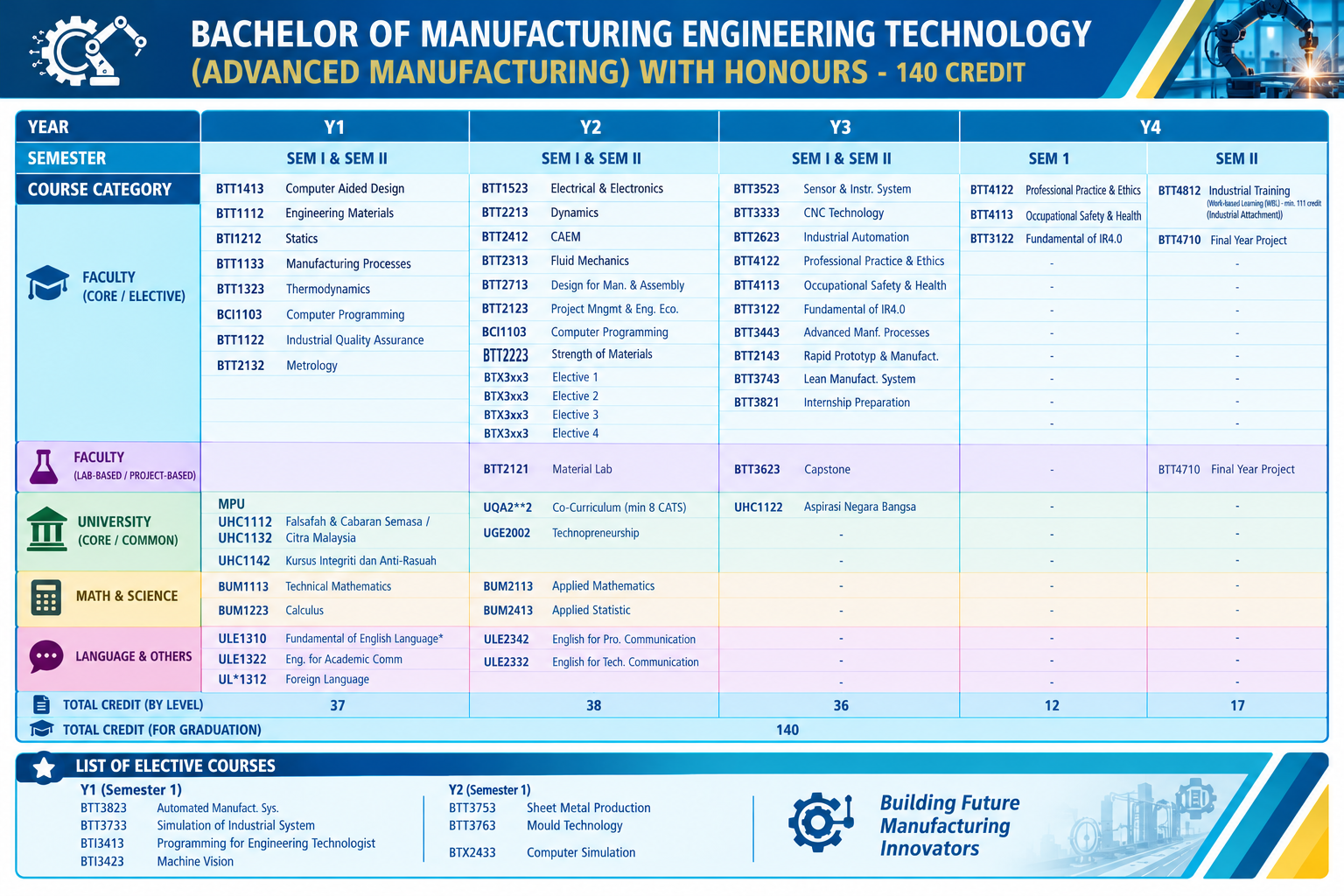
CAD, Engineering Materials, Statics, Manufacturing Processes, Thermodynamics, Metrology and Industrial Quality Assurance are printed here.
Dynamics, Fluid Mechanics, Design for Manufacture and Assembly, Strength of Materials, Material Lab and elective slots appear here.
CNC Technology, Industrial Automation, Advanced Manufacturing Processes, Lean Manufacturing System, Capstone and Internship Preparation appear here.
The chart splits this year into 12 credits in Semester I and 17 in Semester II, with project and industrial training entries.
The chart repeats some titles across years or category bands, including ethics, safety, IR4.0 and the final-year project. Repeated labels are not evidence of separate extra subjects or credits. Get the approved cohort study plan before mapping prerequisites or credit transfer.
The graphic separates faculty core/elective study, lab/project work, university subjects, mathematics/science and languages. It names Technical Mathematics, Calculus, Applied Mathematics and Applied Statistic alongside engineering study. Its image path contains October 2026; that is not proof of the first cohort to use the chart.
The elective panel lists Automated Manufacturing Systems, Simulation of Industrial System, Programming for Engineering Technologist, Machine Vision, Sheet Metal Production, Mould Technology and Computer Simulation. Listing is not a guarantee of every option running every semester, and elective labels should not be converted into an extra compulsory load. Ask which options are approved for your international cohort.
The international admissions page still links two posters marked updated 1 January 2024 under the earlier Manufacturing engineering-technology name. They show an earlier year-based layout: CNC Machining, Automated Manufacturing System, Programmable Logic Controller and Senior Design Project I in Year 3; Computer Integrated Manufacturing, Senior Design Project II, electives and Industrial Training in Year 4.
That layout is not identical to the newer faculty chart. This guide uses the newer chart for its 140-credit reading map, without merging both lists into one compulsory syllabus. Confirm general-study and language requirements, electives, project structure and the qualification name applicable to your offer.
The faculty describes lectures and hands-on laboratory work during the first three years and work-based learning in the final year. It says students apply their knowledge in industry; that programme description does not prove acceptance by a chosen employer.
The current faculty chart places Industrial Training and Final Year Project in the final-year Semester II column and gives final-year semester totals of 12 and 17 credits. Its training label refers to WBL and industrial attachment. MQR separately records seven long semesters and one 24-week industrial-training semester. Those sources are not a named employer agreement or a promise of a paid placement.
Ask for the exact cohort calendar: which assessments take place in industry, how the final-year project is supervised, who approves a host and what happens if a proposed placement is unavailable. International students should confirm placement location, student-pass conditions, safety preparation, insurance, accommodation and travel costs. This page does not promise a factory job or a guaranteed overseas placement.
These requirements come from the dedicated BTM international admissions page. The 50% is attached to the specified subjects. It is not an overall Indian-board eligibility guarantee. Supply the board, exact award, subject list and marks for an individual equivalence assessment.
The page also includes a recognised-diploma option with at least three years of study and age at least 17 at registration. Confirm how that wording applies to your qualification. No automatic advanced entry or fixed credit transfer is established here. Domestic skills-certificate routes should not be substituted for international admission requirements.
The page publishes a practical-work health condition. Applicants with access needs should ask UMPSA for an individual review of practical tasks, adjustments and safety requirements. This guide does not decide an individual admission or accommodation outcome.
Confirm the accepted test version, validity period, preparation charges and progression requirement in the offer. The dedicated page requires the preparation route before the degree starts; it is not a promise of an unconditional degree place.
Published exemption routes concern English-official-language countries or qualifications completed fully in English. Submit the evidence UMPSA requests and obtain its decision. English-medium schooling is not treated here as an automatic exemption for every Indian applicant.
Estimated full-programme standard before approved tuition discounts. Not an annual fee or a personalised invoice.
The exact Manufacturing Engineering Technology (Advanced Manufacturing) award has its own row in the international Engineering Technology table. The estimate covers the minimum/common programme duration; actual registered credits and semester registration can change the amount.
A separate published programme-card price, beside a past February 2026 intake label. The card does not explain its relationship to the newer standard or establish a current personalised discount.
An overall total in a different university schedule, with four years and eight minimum semesters. It is not an extra charge to add to the current standard and not proof of an automatic saving.
The current standard says approved tuition discounts apply at Pekan and Gambang, not Kuala Lumpur. The actual discount and final payable fees belong in the official offer letter. Ask for an intake-specific quote for BTM/FA16395, the full-time mode and your approved campus, with inclusions and refund terms.
Its charging notes list a one-time Semester 1 entrance fee of RM1,155 (approximately ₹26,690) and recurring miscellaneous fees of RM330 (approximately ₹7,626) per semester, which may vary during WBL or training. These describe the charging rules; do not automatically add them a second time to the full-programme estimate.
A separate Personal Bond of RM1,500 (approximately ₹34,663) is due before registration and is refundable in full or part subject to claims. Accommodation/hostel and visa processing are excluded. Budget separately for living costs, travel, insurance, preparation English, personal equipment and placement costs unless the written offer includes them.
INR figures are rounded planning comparisons at Wise’s 10 November 2026 MYR1 = INR23.1085 history entry. They are not current payment quotes. Fees, discounts and schedules remain subject to change.
MQR currently names the Board of Engineers Malaysia as the professional body and gives public-service equivalency as Honours Degree. The faculty’s at-a-glance panel says “MQA (Moving to ETAC)”. Preserve those distinct source statements; do not turn the faculty’s transition wording into a claim that a further accreditation step is already complete.
The programme is Engineering Technology, not the separate Manufacturing Engineering award. Graduation does not itself give a professional engineer licence, universal overseas recognition or unrestricted access to every role labelled engineer. Ask the relevant professional body about the exact registration category, cohort recognition, experience and assessment needed in your intended country.
The DEGI BTM card names UMPSA Kampus Pekan and the Faculty of Manufacturing and Mechatronic Engineering Technology. MQR gives the institution address as Pekan, Pahang. Confirm the actual teaching venue and supervised practical access, and separately confirm where industry learning takes place.
The faculty lists September as an intake month; the DEGI card still displays February 2026, already past. Neither establishes the next open international application window, a vacancy or a visa deadline. Request current offer and registration dates before arranging travel.
The card’s historical account mentions collaboration with Northern Illinois University when the earlier programme began. That history does not establish a current dual award, an overseas exchange place or an American degree for every BTM applicant.
The international admissions page lists manufacturing, process, production, quality, tool, industrial, applications and design engineer directions, alongside manufacturing/process technicians and production-control technologists. These are the university’s career labels, not proof that every graduate meets every employer’s or regulator’s requirements.
Ask whether your assessed work can show a process plan, quality evidence, an automation task and an individual account of a capstone or project. A useful portfolio explains a constraint, compares options, records the result and states what you personally did. No named recruiter, salary, employment rate, machine-vendor certificate or paid internship is promised.
BTM, FA16395: Bachelor of Manufacturing Engineering Technology (Advanced Manufacturing) with Honours. MQR notes the name transition applies from the 2028 graduating cohort.
Yes. The faculty describes four years full-time. MQR allows four to six years within full-time study, not a part-time route.
The faculty chart prints 37, 38 and 36 credits for Years 1–3, followed by 12 and 17 in the final-year semesters: 140 altogether.
The map uses the newer faculty-linked 140-credit chart. The January 2024 admissions posters are retained as older sources, not merged into one syllabus.
The named current standard is RM83,795 (approximately ₹1,936,377). The card and separate summary display different figures; they are not extra charges or guaranteed discounts.
No. The faculty describes final-year work-based learning and MQR lists 24-week industrial training; neither establishes a paid placement, a chosen host or a job.
“The entire admission process was handled in a clear and organized manner, which made everything feel much less overwhelming.”
Fathima Meharin
MBA in Business Analytics · APU Malaysia
“They supported me from the beginning and made sure I understood each step clearly. … Their support made the whole admission process smooth and much less stressful.”
Hamda Noushad
Heriot-Watt University Malaysia
Student experiences as published on Emir Overseas' website, each displayed with five stars. Quotes reproduced exactly as published; the ellipsis is retained. These are not testimonials about the institution on this page.
Checked 11 November 2026. Programme pages, fee schedules and general application instructions can differ. The scope of each source is stated below; written intake-specific confirmation takes priority over an estimate.
Talk to our Malaysia study-abroad experts. We work with 34 partner universities. Your Malaysia study plan, with our Calicut team, starts with your qualification, chosen award, intended intake and a written fee breakdown. The partner count is general, not a claim that this institution is a named partner.
Talk to a study abroad expertOur office: Ground Floor, HiLITE Business Park, Calicut. Please arrange an appointment before visiting.