Explain the electronic system in Malaysia
Circuit Analysis, Digital Electronics, Electronic Devices, Measurement Technology and computer programming form the foundation visible in the cohort plan.

Course guide - Malaysia
From circuit measurements to programmable control, explore the practical side of UMPSA’s Electrical and Electronics diploma. Read the current qualification record, a labelled cohort plan and the limits of published fee figures.

This UMPSA diploma combines electrical and electronics study with technical investigation and practical skills. The current MQR institution list records MQA/FA17367, 90 credits and accreditation from 1 January 2024 to 31 December 2029. The university-hosted MQA statement identifies an MQF Level 4 diploma, full-time study and conventional delivery.
It is not the Electrical Engineering bachelor. The faculty describes technical-specialist aims and skills in troubleshooting, hands-on work and multidisciplinary teams. Treat these as educational aims, not a promise of immediate employment or an electrical competency certificate.
Circuit Analysis, Digital Electronics, Electronic Devices, Measurement Technology and computer programming form the foundation visible in the cohort plan.
Microcontroller Programming and Interfacing, Programmable Logic Controller, Control Systems and Electro Pneumatic are named. They are distinct subjects, not a promise of certification for a commercial automation brand.
Electrical Installation, Electrical Machines, Electrical Power Systems, Maintenance Technology and Occupational Safety and Health link equipment study to responsible technical practice.
The faculty also names computer-aided design among its technical skills. A subject name does not establish the current software licence, laboratory hours or equipment model. Ask for the actual diploma timetable, practical assessment examples and access rules.
Can someone else follow your technical reasoning?
Describe the well-defined problem and the limits of the assigned task. Distinguish supplied information from an assumption.
Show how standard measurements, tests or relevant codes support a conclusion, and what uncertainty remains. Ask what work is assessed under supervision.
Explain the choice of engineering or IT tool and its limitations. A displayed trace or simulation is not, by itself, proof of a safe system.
Make the findings, constraints and instructions understandable to the team. The faculty includes communication, ethics and technician responsibilities.
This is an applicant’s checklist for discussing teaching quality. It is not an advertised student project, a guaranteed fault-finding placement or evidence of access to a particular industrial control system.
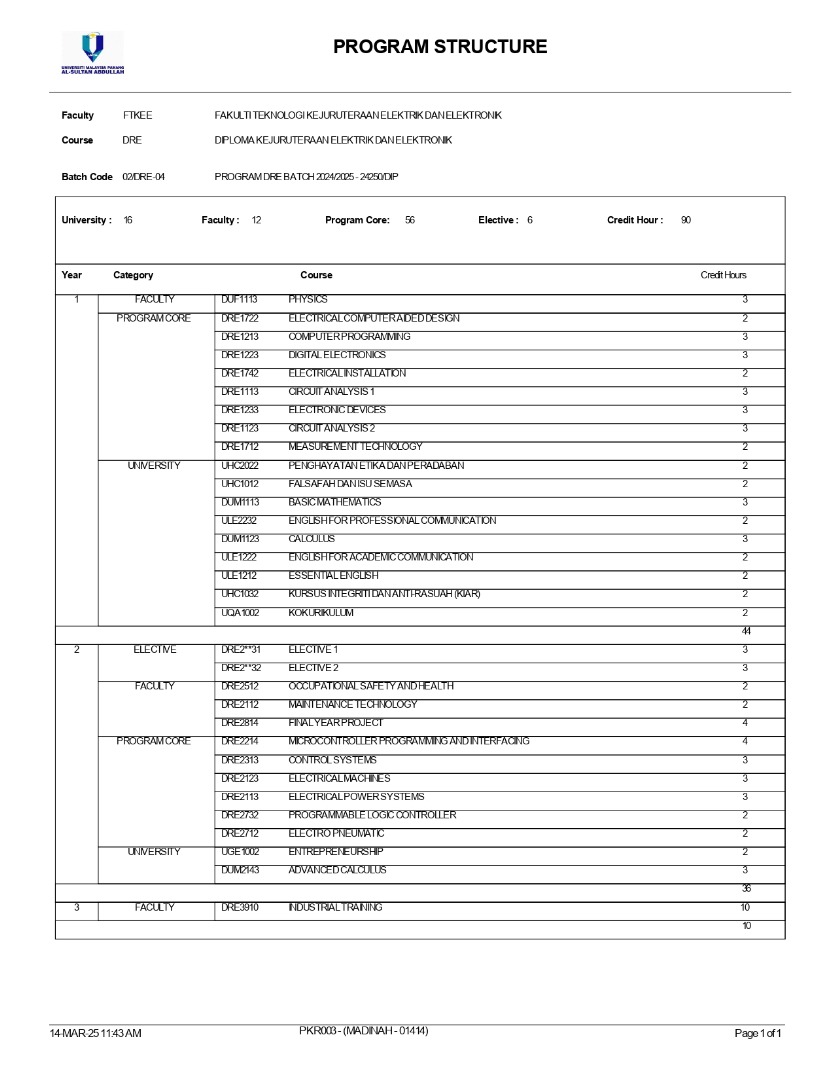
The DEGI card links a one-page DRE PROGRAM STRUCTURE image labelled batch 2024/2025 and stamped 14 March 2025. It groups 44 credits in Year 1, 36 in Year 2 and 10 in Year 3. Its 90-credit classification is 16 university, 12 faculty, 56 programme-core and 6 elective credits. These are the labelled cohort’s figures, not a universal future-intake guarantee.
Physics; Electrical Computer Aided Design; Computer Programming; Digital Electronics; Electrical Installation; Circuit Analysis 1 and 2; Electronic Devices; and Measurement Technology. Mathematics, calculus, English, ethics/philosophy, integrity/anti-corruption study and co-curriculum are also shown.
Microcontroller Programming and Interfacing, Control Systems, Electrical Machines, Electrical Power Systems, Programmable Logic Controller and Electro Pneumatic appear with Maintenance Technology, Occupational Safety and Health, a four-credit Final Year Project, two three-credit electives, Entrepreneurship and Advanced Calculus.
DRE3910 Industrial Training is the final year block. The image assigns 10 credits; the MQA statement separately gives a 20-week training semester. Neither identifies a host employer or states that the attachment is paid.
The faculty webpage also displays a programme sequence starting with Semester 0, then circuit/electronics foundations and later power, control, microcontroller and maintenance subjects. Its extracted second-year list does not clearly label every semester boundary. The image is grouped by year. Do not turn either into an invented semester-by-semester timetable; request the approved plan and elective choices for your cohort.
The MQA statement gives a minimum 2 years 9 months and maximum 5 years. Four long academic semesters, one short semester and one training semester account for six blocks, but their lengths differ. The minimum duration is not a guarantee after repeat subjects, delayed attachment or extended registration.
For training, ask who approves and arranges the host, what tasks and supervision are allowed, reporting requirements and the fallback if a placement cannot be secured. Clarify international-student rules and costs for travel, accommodation and insurance. Programme enrolment does not guarantee pay, a future job or work permission.
Use the dedicated international admissions page rather than converting the separate domestic SPM route into an Indian eligibility rule. The 50% is a specified-subject threshold, not an overall Indian-board cutoff. Ask admissions to assess your actual board, certificate, subjects and marks, including whether your qualification is equivalent for this diploma.
The page also publishes practical-work health and colour-vision conditions. Applicants with access needs should request an individual assessment of the activities, adjustments and safety requirements. A general web guide cannot decide an individual’s admission or accommodation outcome.
Confirm which test version and validity period apply to your intake. If preparation is needed, obtain its price, duration and progression condition before budgeting. Preparation is not an unconditional diploma place.
Admissions describes exemption routes for English-official-language countries or qualifications taught fully in English. Supply the required evidence and obtain an individual decision. An Indian school’s English-medium label alone is not treated here as an automatic waiver.
Full-programme international estimate before approved tuition discounts. This is not annual tuition, a personalised invoice or a guaranteed discounted price.
A lower published figure is not a scholarship award or a confirmed saving. Ask for a dated full-time international quotation for FA17367 that states intake, teaching campus, discount conditions and every inclusion or exclusion. The current standard schedule notes that actual credit registration may affect charges, discounts need university approval and the rates concern Pekan/Gambang, not Kuala Lumpur.
The standard fee notes list a one-time Semester 1 entrance fee of RM1,155 (approximately ₹26,690) and miscellaneous charges of RM330 (approximately ₹7,626) per semester, with variation for industrial training or Work-Based Learning. These describe the schedule’s charging rules, not automatic additions on top of the programme estimate.
A separate Personal Bond of RM1,500 (approximately ₹34,663) is due before registration and refundable in full or part subject to claims. Hostel and visa processing are excluded. Living costs, travel, insurance, tools/equipment, English preparation and attachment costs need their own figures unless the written offer includes them.
All INR figures are rounded comparisons at Wise’s 10 November 2026 MYR1 = INR23.1085. They are for planning, not current payment or currency-transfer quotes.
The live MQR list has separate entries: current FA17367 accredited 2024-2029, and FA9501, the older Electrical and Electronics diploma record ending 31 December 2023. The DEGI page still displays FA9501 and is addressed with that code. Its price, illustrative image and linked curriculum are separately attributed; its old code is not used to prove current accreditation.
The university-hosted MQA statement names Board of Engineers Malaysia and public-service equivalency as Diploma in Engineering. This does not grant individual Graduate Engineer or Professional Engineer registration, an electrician or electrical-competency licence, independent installation/sign-off powers, overseas recognition or permission to work. Check the exact role with the relevant regulator.
FTKEE’s contact identifies Pekan Campus, 26600 Pekan, Pahang. The hosted MQA statement carries the older Gambang/Kuantan institution address and lists Pekan as additional premises. The DEGI card says only “UMPSA Campus Pahang”. These address fields do not by themselves settle where every diploma laboratory or class meets.
The card’s July 2027 label is not live confirmation of international vacancies or an exact closing date. Have the offer name the teaching site, current award code, registration dates and Student Pass conditions. Do not book travel on the assumption that a faculty postal address is a confirmed classroom location.
The official pages name oil and gas, automotive, manufacturing, building services/maintenance and electronics. Their examples include equipment, system, service, field, maintenance, QA, control/instrumentation and technical-support technician roles, plus production assistant and site-supervisor directions. These are examples, not confirmed vacancies, salaries or recruitment guarantees.
If a role is labelled electrician, check its statutory competency requirements rather than treating the diploma as the licence. For control or instrumentation work, ask employers which practical experience, safety training and equipment knowledge they require. Faculty technical-specialist aims should not be reworded as Professional Engineer status.
The faculty also lists further study as an educational aim. Any bachelor admission, credit transfer or shortened duration needs a separate written assessment from the receiving institution; no fixed progression deal is established by the pages used here.
No. FA17367 is an MQF4 diploma with 90 credits. It is separate from UMPSA electrical-engineering degree awards and does not confer their degree-level qualification.
FA17367 is accredited 1 January 2024 to 31 December 2029. The DEGI card retains FA9501, whose older record ended in 2023.
The MQA structure is four 17-week long semesters, one nine-week short semester and one 20-week industrial-training semester. Its minimum period is 2 years 9 months, not six identical teaching semesters.
The DRE 2024/25 image stamped 14 March 2025 shows 44 + 36 + 10 credits. It includes circuits, electronics, measurement, microcontroller/PLC/control, power/machines and training. Confirm the current intake plan.
The current named standard estimate is RM37,805 (approximately ₹873,617) before approved discounts. The fee table separately attributes the card and summary figures, with exclusions and bond explained.
The award is not presented as an individual electrical competency or electrician licence. Check the regulator and job requirements for the work you intend to do.
“The entire admission process was handled in a clear and organized manner, which made everything feel much less overwhelming.”
Fathima Meharin
MBA in Business Analytics · APU Malaysia
“They supported me from the beginning and made sure I understood each step clearly. … Their support made the whole admission process smooth and much less stressful.”
Hamda Noushad
Heriot-Watt University Malaysia
Student experiences as published on Emir Overseas' website, each displayed with five stars. Quotes reproduced exactly as published; the ellipsis is retained. These are not testimonials about the institution on this page.
Checked 11 November 2026. Programme pages, fee schedules and general application instructions can differ. The scope of each source is stated below; written intake-specific confirmation takes priority over an estimate.
Talk to our Malaysia study-abroad experts. We work with 34 partner universities. Your Malaysia study plan, with our Calicut team, starts with your qualification, chosen award, intended intake and a written fee breakdown. The partner count is general, not a claim that this institution is a named partner.
Talk to a study abroad expertOur office: Ground Floor, HiLITE Business Park, Calicut. Please arrange an appointment before visiting.