Course guide - Malaysia

Electrical Energy in Malaysia: UMPSA Circuits, Control and Solar Study

Follow electrical energy from measurement and machines to control and photovoltaic operation. Check UMPSA’s exact BTE award, five innovation laboratories, energy subjects and the offer details behind its international fees.

Illustrative helmeted people beside solar panels with a clipboard, from UMPSA’s BTE card
Image: UMPSA DEGI BTE card, prog-BTE-3905.png. Programme illustration, not proof of a named student, UMPSA solar farm, equipment access or employer placement.

Malaysia Electrical Energy: a specific technology bachelor

This guide covers UMPSA’s Bachelor of Electrical Engineering Technology (Energy) with Honours, programme code BTE. MQR records FA16394, certificate 31418, MQF Level 6 and 141 credits, with accreditation from 1 January 2023 to 31 December 2028. The professional body named is the Board of Engineers Malaysia.

141 creditscurrent MQR total
4 yearsDEGI standard duration
Pekanprogramme-card campus
2028accreditation period ends

This is not the Electrical and Electronics Engineering diploma, the Robotics Engineering Technology bachelor or the separate Electrical Engineering award. Match the full Energy engineering-technology title and BTE code to your offer.

MQR calls this a transition from FA2291. It gives the earlier title Bachelor of Engineering Technology (Electrical) with Honours and says the latest name is effective from the 2028 graduating cohort. That is a graduating-cohort condition, not permission to relabel every earlier graduate. Historical duration entries show 142 credits before the current 141-credit total; do not combine both.

The DEGI card gives four years. MQR lists a four-to-six-year full-time range and conventional delivery. That maximum completion range is not a part-time offer. This guide is for campus, full-time undergraduate study only.

Malaysia energy study: from circuits to renewable-system operation

01 / MEASURE

Circuits and instrumentation in Malaysia

The dedicated admissions posters name Instrumentation and Measurement and Circuit Analysis I and II. Ask how students collect measurements and explain differences between a calculated and observed circuit response.

02 / CONVERT

Machines and power in Malaysia

Electrical Machine and Transformers, Electrical Power System and Power Electronics are named subjects. Ask how assessed practical work connects equipment behaviour, protection and safe operation.

03 / CONTROL

PLC and SCADA in Malaysia

The innovation-laboratory sequence names PLC Application and SCADA. Ask what students configure or test themselves, how faults are assessed and whether individual work is documented.

04 / USE

Renewable energy and PV in Malaysia

The later semesters name Fundamentals of Renewable Energy, Electrical Energy Utilization and Management, and Photovoltaic System Operation and Maintenance. These subjects do not by themselves award an installer or energy-manager licence.

The DEGI card describes daytime, face-to-face theoretical and laboratory teaching, hardware/software design and implementation, machines, power systems and controls. The image depicts two helmeted people beside solar panels; it is a credited programme illustration, not proof of a UMPSA solar farm, a named student or a guaranteed site visit.

Malaysia BTE evidence map: five innovation labs, then an energy focus

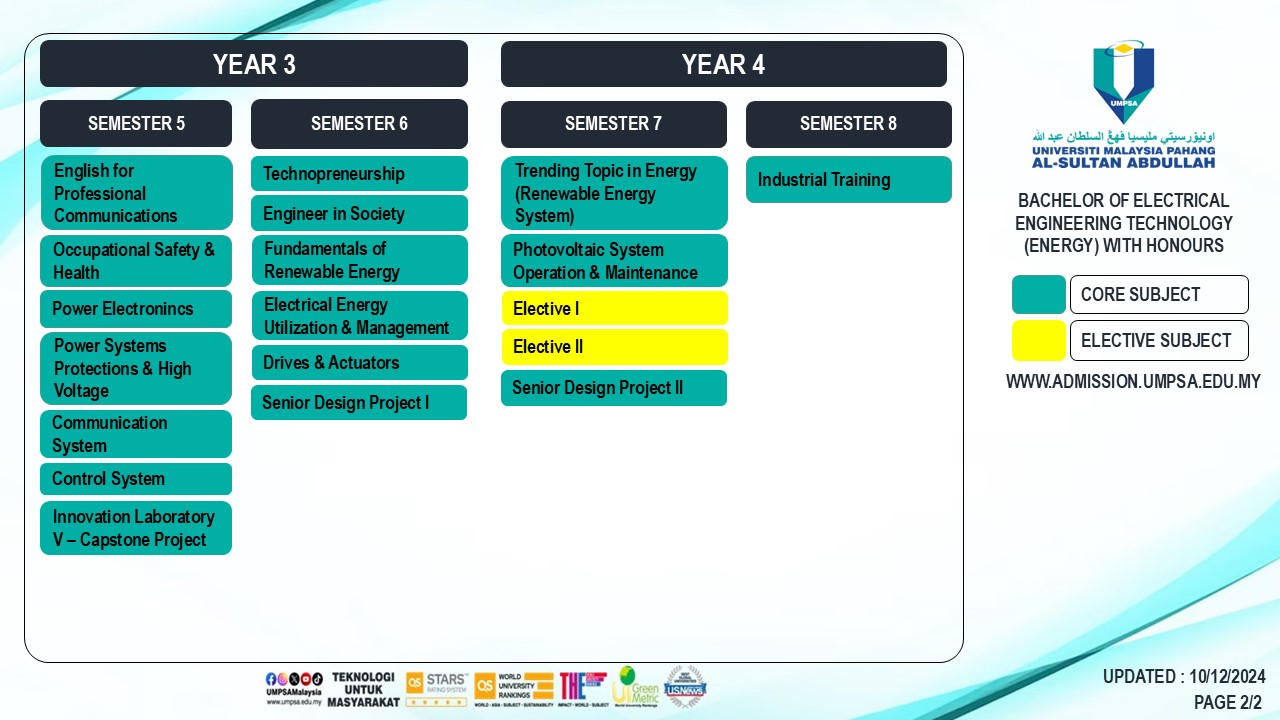
Redrawn sequence from the dedicated BTE international admissions posters, stamped “UPDATED: 10/12/2024”. Semester locations are printed; arrows indicate reading order, not verified prerequisites or separately awarded certificates.
SEMESTER 1 · LAB ICAD & PCB

Innovation Laboratory I introduces the CAD and PCB label alongside programming, digital electronics and measurement subjects.

SEMESTER 2 · LAB IIProgramming

Innovation Laboratory II has a Python-programming label, spelled “Phython” in the poster. Confirm the actual taught language and tools in the cohort plan.

SEMESTER 3 · LAB IIIPLC application

Innovation Laboratory III sits beside Circuit Analysis II, Analog Electronics and Electromagnetic Field Theory.

SEMESTER 4 · LAB IVSCADA

Innovation Laboratory IV appears with Microcontroller Programming and Interfacing, Signal and Systems, power systems and machines.

SEMESTER 5 · LAB VCapstone project

Innovation Laboratory V appears with Control System, Communication System, Power Electronics, protection/high voltage and safety.

Energy focus: Semesters 6 and 7
WITHIN THE 141-CREDIT MQR AWARDRenewable energy → energy use and management → photovoltaic operation and maintenance

Semester 6 includes renewable-energy fundamentals, electrical energy utilisation/management and Drives and Actuators. Semester 7 includes a renewable-energy trending-topic subject and Photovoltaic System Operation and Maintenance. This is a topic map, not a credit allocation.

Senior Design Project I appears in Semester 6 and Senior Design Project II in Semester 7, alongside two elective slots. Industrial Training occupies Semester 8. The posters do not print a per-subject credit allocation here, so this page does not invent one or add the laboratories to the 141-credit total a second time.

Ask to see the current lab assessment method, electrical safety rules, supervision, equipment access and any software costs. No PLC manufacturer, SCADA platform, CAD licence, PCB fabrication facility or photovoltaic hardware brand is verified by these subject labels.

Malaysia BTE curriculum versions: use the dated Energy posters

The faculty also retains an earlier-title BTE page with a different structure: separately named circuit-analysis labs, Electric Machines and Transformers laboratory, Microprocessor and Interfacing laboratory, and three final-year elective slots. The dedicated international Energy posters instead show the five Innovation Laboratories and two Semester 7 electives.

These are distinct published layouts. This page uses the dated international Energy posters for its subject sequence and keeps the older faculty page as background, not a combined compulsory list. Obtain the approved international study plan for your entry cohort, including exact subject credits, elective choices, general-study and language requirements. The MQR record establishes the current qualification total, not every line of an individual timetable.

Malaysia industrial training: a final semester, not a job promise

The international posters place Industrial Training in Semester 8. MQR records seven long semesters and one 24-week industrial-training semester within the full-time programme. Do not turn that final semester into a guaranteed year-long employer placement or add an extra year to the card’s four-year duration.

Senior Design Project I and II are separate named study components in Semesters 6 and 7. Their presence is not evidence of a particular commercial client or a paid industry project. Ask who proposes the topic, approves the host, supervises electrical tasks and assesses individual work.

International students should confirm placement location, student-pass conditions, insurance, safety induction, transport, accommodation and any additional costs. Ask what happens if a chosen host is unavailable. No solar company, utility, offshore employer, paid placement or employment outcome is guaranteed here.

Malaysia international entry: match subjects, not an assumed board cutoff

School qualificationHSC / A-Level / equivalent; three subjects at C or above
Specified subjectsMathematics + two related Science/Technology subjects
Specified subject thresholdC grade / 50% / CGPA 2.00
Diploma alternativeRecognised diploma/equivalent, subject to Senate approval

These requirements come from the dedicated BTE international admissions page. The 50% is attached to the specified subjects. It is not an overall Indian-board eligibility guarantee. Supply the board, exact award, subject list and marks for an individual equivalence assessment.

The page also includes a recognised-diploma option with at least three years of study and age at least 17 at registration. Confirm how that wording applies to your qualification. No automatic advanced entry or fixed credit transfer is established here. Domestic skills-certificate routes should not be substituted for international admission requirements.

The page publishes practical-work conditions and explicitly says candidates must not be colour blind. Applicants with access or colour-vision concerns should ask UMPSA for an individual review of practical tasks, safety requirements and possible adjustments before relying on eligibility. This guide does not decide an individual admission or accommodation outcome.

Malaysia English evidence for the Electrical Energy route

IELTS / TOEFLIELTS 4.0; TOEFL PBT 500 or iBT 30–31
Other listed testsMUET Band 3; PTE 36; Cambridge C1/C2 140
Below the listed minimumPreparatory Intensive English, then MUET Band 3

Confirm the accepted test version, validity period, preparation charges and progression requirement in the offer. The dedicated page requires the preparation route before the degree starts; it is not a promise of an unconditional degree place.

Published exemption routes concern English-official-language countries or qualifications completed fully in English. Submit the evidence UMPSA requests and obtain its decision. English-medium schooling is not treated here as an automatic exemption for every Indian applicant.

Malaysia Electrical Energy international fees: the current row comes first

INTERNATIONAL STANDARD · 2025/26 ONWARDSRM83,795≈ ₹1,936,377

Estimated full-programme standard before approved tuition discounts. Not an annual fee or a personalised invoice.

Malaysia current bursar row: specialisation not printed

RM83,795 (approximately ₹1,936,377)

The international Engineering Technology table has a row titled “Bachelor of Electrical Engineering Technology with Honours”, without the Energy specialisation in that row. Treat its standard as a reference and confirm in writing that it applies to BTE/FA16394. The estimate covers the minimum/common programme duration; actual registered credits and semester registration can change the amount.

Malaysia DEGI BTE card display

RM65,930 (approximately ₹1,523,543)

A separate published programme-card price, beside a past February 2026 intake label. The card does not explain its relationship to the newer standard or establish a current personalised discount.

Malaysia separate international summary: BTE

RM53,510 (approximately ₹1,236,536)

An overall total in a different university schedule, with four years and eight minimum semesters. It is not an extra charge to add to the current standard and not proof of an automatic saving.

The current standard says approved tuition discounts apply at Pekan and Gambang, not Kuala Lumpur. The actual discount and final payable fees belong in the official offer letter. Ask for an intake-specific quote for BTE/FA16394, the full-time mode and your approved campus, with inclusions and refund terms.

Its charging notes list a one-time Semester 1 entrance fee of RM1,155 (approximately ₹26,690) and recurring miscellaneous fees of RM330 (approximately ₹7,626) per semester, which may vary during WBL or training. These describe the charging rules; do not automatically add them a second time to the full-programme estimate.

A separate Personal Bond of RM1,500 (approximately ₹34,663) is due before registration and is refundable in full or part subject to claims. Accommodation/hostel and visa processing are excluded. Budget separately for living costs, travel, insurance, preparation English, personal equipment and placement costs unless the written offer includes them.

INR figures are rounded planning comparisons at Wise’s 10 November 2026 MYR 1 = INR 23.1085 history entry. They are not current payment quotes. Fees, discounts and schedules remain subject to change.

Malaysia recognition: engineering technology is not a personal licence

The current MQR record names the Board of Engineers Malaysia and gives public-service equivalency as Honours Degree. That is programme-level information for FA16394. Do not borrow a recognition claim from a different Electrical Engineering, diploma or Robotics programme.

Graduation does not by itself confer professional engineer registration, an electrical competency certificate, a photovoltaic installer licence or unrestricted overseas recognition. Ask the relevant regulator about the category, recognised cohort, experience, assessment and local requirements needed for the work you intend to do.

Malaysia Pekan campus: verify the live intake offer

The DEGI BTE card names UMPSA Kampus Pekan and the Faculty of Electrical and Electronic Engineering Technology. MQR gives the institution address as Pekan, Pahang. Confirm the actual teaching address and supervised laboratory facilities, then separately confirm the training venue.

The card still displays February 2026, already past at this check. It does not establish an upcoming vacancy or deadline. Request the current international application, registration and student-pass timeline before arranging travel.

Malaysia electrical-energy careers: evidence matters more than labels

The dedicated international page lists Electrical Engineering Technologist, maintenance, operation/production, product/system design, development/testing, field, systems and quality-control directions, alongside technical management, sales/procurement and self-employment. Those are the university’s role labels, not proof that a graduate qualifies for every regulated title or employer.

A useful portfolio could show measured circuit behaviour, a documented automation task, a safety-aware energy-system decision and the student’s own contribution to a design project. Ask which of these are assessed, rather than assuming every laboratory label produces a finished commercial project. No named recruiter, salary, employment rate or utility-company placement is established here.

Malaysia Electrical Energy degree questions

Which Malaysia electrical-energy award is covered?

BTE, Bachelor of Electrical Engineering Technology (Energy) with Honours, FA16394. MQR records 141 credits and a name transition effective from the 2028 graduating cohort.

Is this Malaysia route the same as the E&E diploma?

No. BTE is an MQF Level 6 full-time bachelor with energy, power-system and renewable-energy subjects. It is also distinct from Robotics and the separate Electrical Engineering award.

What does the Malaysia innovation-lab map show?

Five laboratories across Semesters 1–5: CAD/PCB, programming, PLC, SCADA and capstone. The order is not a verified prerequisite chain or a set of vendor certificates.

Where does Malaysia photovoltaic study appear?

The international poster places Photovoltaic System Operation and Maintenance in Semester 7 after renewable-energy and energy-management topics in Semester 6.

What is the Malaysia international fee estimate?

The current Electrical Engineering Technology standard is RM83,795 (approximately ₹1,936,377). The programme-card and separate summary figures are different published scopes, not extra charges or automatic discounts.

Does Malaysia study give an electrical or solar licence?

Not automatically. Programme accreditation, graduation, professional registration and competency or installer licences are separate checks.

Student experiences with our Malaysia guidance

★★★★★
“The entire admission process was handled in a clear and organized manner, which made everything feel much less overwhelming.”

Fathima Meharin

MBA in Business Analytics · APU Malaysia

★★★★★
“They supported me from the beginning and made sure I understood each step clearly. … Their support made the whole admission process smooth and much less stressful.”

Hamda Noushad

Heriot-Watt University Malaysia

Student experiences as published on Emir Overseas' website, each displayed with five stars. Quotes reproduced exactly as published; the ellipsis is retained. These are not testimonials about the institution on this page.

Official sources for this Malaysia guide

Checked 11 November 2026. Programme pages, fee schedules and general application instructions can differ. The scope of each source is stated below; written intake-specific confirmation takes priority over an estimate.

  1. MQA: detailed FA16394 record - Certificate 31418, 2023–2028, 141 credits, MQF6, BEM, full-time 4–6 years, 24-week training; historical 142 credits and 2028 graduating-cohort name transition.
  2. UMPSA FTKEE: full-time programmes - Daytime, face-to-face theory/lab format and electrical technology overview.
  3. UMPSA international admissions: BTE Energy - International school/diploma entry, English, practical-work/colour-vision conditions and career labels.
  4. UMPSA BTE international poster1 - Stamp 10/12/2024; Semesters 1–4, Innovation Labs I–IV, circuit/machine/power/automation topics.
  5. UMPSA BTE international poster2 - Semesters 5–8, Lab V, energy/PV subjects, Senior Design Projects I/II, two electives and training.
  6. UMPSA FTKEE: earlier-title BTE page - Different published structure; background only, not merged into Energy posters.
  7. UMPSA bursar: current international standard - Electrical Engineering Technology row without Energy suffix, 2025/26 onwards, discounts, charging notes, bond/exclusions.
  8. UMPSA bursar: separate international summary - Separate BTE total, four years/eight semesters, not added to standard.
  9. UMPSA DEGI: BTE card - Pekan, four years, separate displayed price, past February 2026 and credited solar illustration.
  10. Wise: MYR exchange-rate history - 10 November 2026 MYR 1 = INR 23.1085 planning basis.
  11. Emir Overseas: published testimonials - Guidance-service experiences, not reviews of this degree.

Build your Malaysia study plan.

Talk to our Malaysia study-abroad experts. We work with 34 partner universities. Your Malaysia study plan, with our Calicut team, starts with your qualification, chosen award, intended intake and a written fee breakdown. The partner count is general, not a claim that this institution is a named partner.

Talk to a study abroad expertOur office: Ground Floor, HiLITE Business Park, Calicut. Please arrange an appointment before visiting.