Mechanical and electronic foundations in Malaysia
The faculty names programming, computer-aided design/manufacturing, electrical and electronics, and machine design. These provide context for a robot as a physical system, not only an AI application.

Course guide - Malaysia
Explore the meeting point of mechanisms, electronics and intelligent control. Compare UMPSA’s exact Robotics technology award, its published curriculum versions and the costs and questions behind final-year Work-Based Learning.

UMPSA’s Bachelor of Mechatronic Engineering Technology (Robotics) with Honours combines mechanical systems, electronics, computing and control with a robotics focus. The faculty lists four years and full-time study. The current Malaysian Qualifications Register institution list records MQA/FA14595, 140 credits and accreditation from 1 January 2025 to 31 December 2030.
This is an engineering technology award, not the Bachelor of Engineering (Honours) Mechatronics Engineering and not the separate German collaborative programme. Match the full award title and FA14595 on the offer. Similar subject words do not make the awards, professional routes or admission conditions interchangeable.
The faculty names programming, computer-aided design/manufacturing, electrical and electronics, and machine design. These provide context for a robot as a physical system, not only an AI application.
Sensor instrumentation, artificial intelligence, machine vision and applied machine learning appear in the faculty description. The linked infographic also lists autonomous robotic systems among elective choices.
Control systems, industrial IoT, rapid prototyping and robotic-system modelling connect hardware to software. Ask how a project is assessed across sensing, control and mechanical constraints.
A named topic does not prove access to a particular robot brand, vision camera, software licence or laboratory schedule. Ask for the current equipment list, supervised lab access, team sizes and examples of assessed student work. The university’s programme-card image is credited below the hero; it does not identify a guaranteed machine or placement available to every student.
Which sensor or image supplies the evidence? Ask how measurement limits, lighting or noise are tested in supervised coursework.
What does the controller or learning model predict? Ask how students separate a training result from performance on new cases.
How do the electronics, mechanism and control respond together? Discuss simulation and supervised validation, not unsupervised machine operation.
What happens when a reading or action is wrong? Ask how safety, test records and engineering judgement enter the assessment.
A polished demonstration is only part of the evidence. Request a sample project brief, test report and marking rubric. For group projects, ask how individual contributions are recorded. No accuracy, speed, industrial certification or employer endorsement is promised by this graphic.
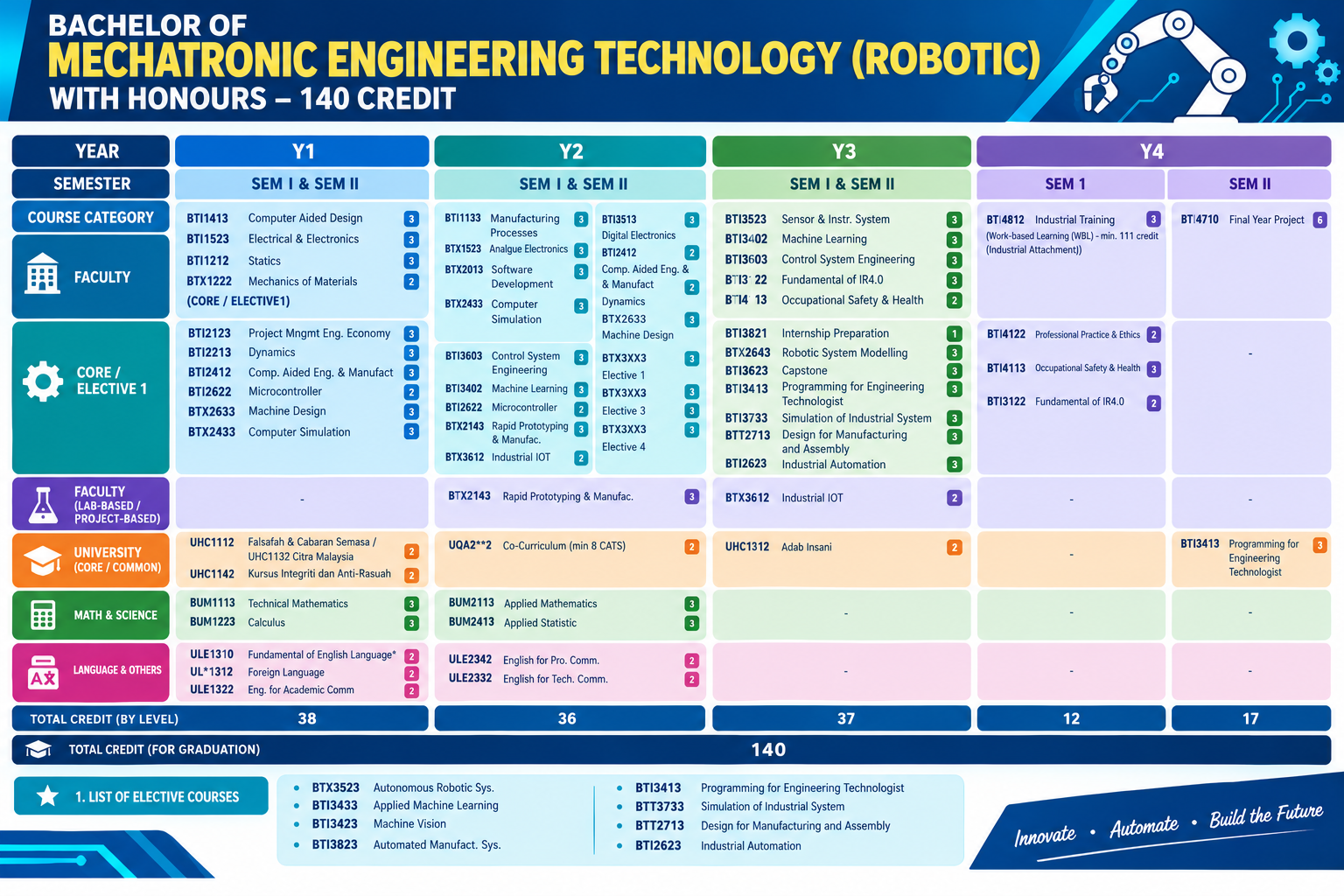
The faculty links a curriculum infographic in a URL dated 15 October 2026. It labels 140 graduation credits and year totals of 38, 36 and 37, followed by 12 and 17 for the two final-year semesters. These add to 140. The URL date is not treated as a formal cohort-effective date. Its title uses “Robotic” in the singular; the formal award title in MQR and the faculty page is “Robotics”.
The infographic includes Computer Aided Design, Electrical & Electronics, Statics, Mechanics of Materials, technical mathematics, calculus and communication study. It also displays project-management/economy and computing-related entries.
Manufacturing Processes, Analogue Electronics, Software Development, Digital Electronics, Microcontroller, Machine Design, Computer Simulation and Rapid Prototyping & Manufacturing appear in the displayed plan.
Sensor & Instrumentation System, Machine Learning, Control System Engineering, Internship Preparation, Robotic System Modelling and Capstone are among the displayed entries. Elective offerings and combinations need confirmation.
The final-year columns include Industrial Training, Professional Practice & Ethics, Occupational Safety & Health, Fundamental of IR4.0 and a six-credit Final Year Project. Do not interpret 3U1I as a year with no academic assessment.
The infographic repeats some subject names across categories or years, and some printed codes are incomplete. It is not used here to reconstruct a definitive semester registration list or to add duplicate subject credits. The older admissions posters, each marked updated 1 January 2024, show a different grouping across four years. They are retained as earlier illustrations, not silently combined with the newer faculty graphic. Request the approved study plan for your entry cohort, elective rules and credit prerequisites.
The faculty describes three years of lectures and laboratory work followed by final-year Work-Based Learning. The bursar places the award in its Engineering Technology (3U1I) category. The linked infographic labels Industrial Training as three credits and includes “min. 111 credit” beside Work-Based Learning/Industrial Attachment. This is not presented here as a 111-credit placement; ask the faculty to explain the prerequisite and registration rule.
The faculty says students will be placed in a company of their choice. Treat that as the programme’s published description, not an unconditional right to any employer. Before accepting, ask who secures and approves the host, how international students are placed, what happens if a preferred company declines, and which tasks, supervision and assessment are required.
Obtain the actual attachment calendar, insurance requirements, travel and accommodation costs, and rules for any placement outside the teaching campus. Nothing in the sources used establishes that every attachment is paid, that a particular robotics employer participates or that training leads to a job. Enrolment does not itself grant unrestricted work permission.
The dedicated international page gives these school and subject routes. The 50% is a specified-subject threshold, not an invented overall Indian-board admission cutoff. Ask UMPSA to assess your board, award, subjects and marks individually. The page also includes a recognised-diploma route with a minimum three-year duration and age at least 17 at registration; confirm how this applies to the qualification you hold.
Do not import the domestic STPM, SPM or skills-diploma rules into an Indian application. The faculty’s local-entry images are not an international equivalence table. A diploma application does not establish automatic entry into Year 2 or a fixed amount of credit transfer.
The admissions page publishes a practical-work health condition. Applicants with access needs should ask for an individual assessment of practical activities, adjustments and safety requirements. This guide cannot determine an individual’s admission or accommodation outcome.
The page says the preparation requirement must be met before the diploma or degree programme begins. Confirm accepted test versions, validity periods, preparation fees and progression conditions for your intake. Preparation is not an unconditional degree place.
Published exemption routes concern English-official-language countries or qualifications from institutions where English is the full medium of instruction. Supply the required evidence and obtain an individual decision. An Indian school’s English-medium description is not treated here as an automatic exemption.
Full-programme estimate before approved tuition discounts, not annual tuition or a personalised invoice.
A lower published number is not a confirmed scholarship or saving. Get a dated international offer for the exact Robotics award, entry intake and teaching campus. Have it list approved discounts and every inclusion and exclusion. The current standard notes that fees may vary with registered credits and semester registration, and its Pekan/Gambang discounts do not apply to Kuala Lumpur.
The standard notes describe a one-time Semester 1 entrance fee of RM1,155 (approximately ₹26,690) and recurring miscellaneous charges of RM330 (approximately ₹7,626) per semester, with variation during WBL or industrial training. They explain the schedule’s charging rules and are not automatically added again above the programme estimate.
A separate Personal Bond of RM1,500 (approximately ₹34,663) is due before registration and is refundable in full or part subject to claims. Hostel and visa processing are excluded. Budget separately for living costs, insurance, travel, equipment/software, English preparation and attachment-related expenses unless the written offer includes them.
INR amounts are rounded planning comparisons at Wise’s 10 November 2026 MYR1 = INR23.1085. They are not current transfer rates or payment quotes.
The current MQR institution list establishes FA14595, 140 credits and the 2025–2030 accreditation period. The faculty labels accreditation as TTAC (MBOT). This guide attributes that label to the faculty; it does not turn it into an independently verified individual registration entitlement.
Completing an accredited technology degree does not automatically award Professional Engineer, Graduate Engineer or Professional Technologist status, a practising licence or overseas recognition. Check the relevant professional body’s current registration and experience requirements for your intended work. Do not substitute the accreditation of a different UMPSA Mechatronics Engineering programme.
The DEGI BTR card names UMPSA Kampus Pekan and the Faculty of Manufacturing and Mechatronic Engineering Technology. The faculty’s own contact is at Pekan, Pahang. Confirm the exact classroom/laboratory location and where final-year WBL will take place in your offer and placement documents.
The faculty overview says September, while the DEGI card still displays February 2026, a past intake at the time of this check. Neither is live evidence of a forthcoming international vacancy or closing date. Ask for current intake dates, registration deadlines and Student Pass conditions before paying for travel.
The international page lists development/testing, product or system design, production/operations, maintenance, technical management and quality-control directions. Its introduction uses the broad phrase “Electrical Engineering Technologist”; that wording is not used here to relabel the Robotics degree or establish a professional title.
For robotics roles, compare the tasks with the course’s actual assessed work: sensing, control, embedded software, mechanisms, machine vision or system integration. Ask employers which portfolio evidence, safety training and experience they expect. Academic careers usually need further qualifications; a bachelor alone is not a promise of a lecturer appointment.
No source used establishes salaries, named recruiting employers, employment rates or guaranteed postgraduate admission. Any later credit recognition, professional registration or immigration outcome needs its own assessment.
No. This page concerns Bachelor of Mechatronic Engineering Technology (Robotics) with Honours, FA14595. The engineering and German collaborative awards are separate.
The faculty lists four years, full-time. The current MQR list records140 credits and accreditation from1January2025 to31December2030.
No. The faculty describes Work-Based Learning and the fee table uses3U1I, but the sources do not establish pay, a named host or employment after completion. Confirm placement arrangements and assessment.
The faculty-linked infographic totals140 credits but contains repeated names and incomplete codes. The admissions posters are marked1January2024 and differ. Request the approved plan for your cohort rather than merging them.
The named current bursar estimate is RM83,795 (approximately ₹1,936,377) before approved discounts. The page separately attributes the card and older summary totals, bond and exclusions.
No. Programme accreditation and individual professional registration are different. Confirm requirements with the relevant body for the role and country in which you intend to work.
“The entire admission process was handled in a clear and organized manner, which made everything feel much less overwhelming.”
Fathima Meharin
MBA in Business Analytics · APU Malaysia
“They supported me from the beginning and made sure I understood each step clearly. … Their support made the whole admission process smooth and much less stressful.”
Hamda Noushad
Heriot-Watt University Malaysia
Student experiences as published on Emir Overseas' website, each displayed with five stars. Quotes reproduced exactly as published; the ellipsis is retained. These are not testimonials about the institution on this page.
Checked 11 November 2026. Programme pages, fee schedules and general application instructions can differ. The scope of each source is stated below; written intake-specific confirmation takes priority over an estimate.
Talk to our Malaysia study-abroad experts. We work with 34 partner universities. Your Malaysia study plan, with our Calicut team, starts with your qualification, chosen award, intended intake and a written fee breakdown. The partner count is general, not a claim that this institution is a named partner.
Talk to a study abroad expertOur office: Ground Floor, HiLITE Business Park, Calicut. Please arrange an appointment before visiting.