Define the work in Malaysia
Principles of Management, Project Management and Integrated Project Management I and II connect the project to its purpose.
Ask to see how a student defines scope, deliverables and acceptance criteria.

Course guide - Malaysia
A project is more than a deadline. Explore how UMPSA’s undergraduate degree connects scope, time, cost, procurement and people, then separate academic recognition from professional certification and an individual industry offer.

Bachelor of Project Management with Honours is the exact UMPSA award, MQA/FA2288. The Malaysian Qualifications Register lists MQF Level 6, 120 credits and Full Time study, with eight 17-week long semesters over four years. Accreditation starts on 19 June 2012, with no end date displayed. This is an undergraduate degree, not an MBA, a part-time executive programme or a short professional-certification course.
The current international open-intake card names a Pahang campus. MQR gives the institution’s Pekan address and also records programme delivery at Lebuh Persiaran Tun Khalil Yaakob, 26300 Kuantan. Those are not interchangeable confirmations of your teaching location. Ask for the exact campus and the industrial-mode arrangements on the offer before choosing accommodation.
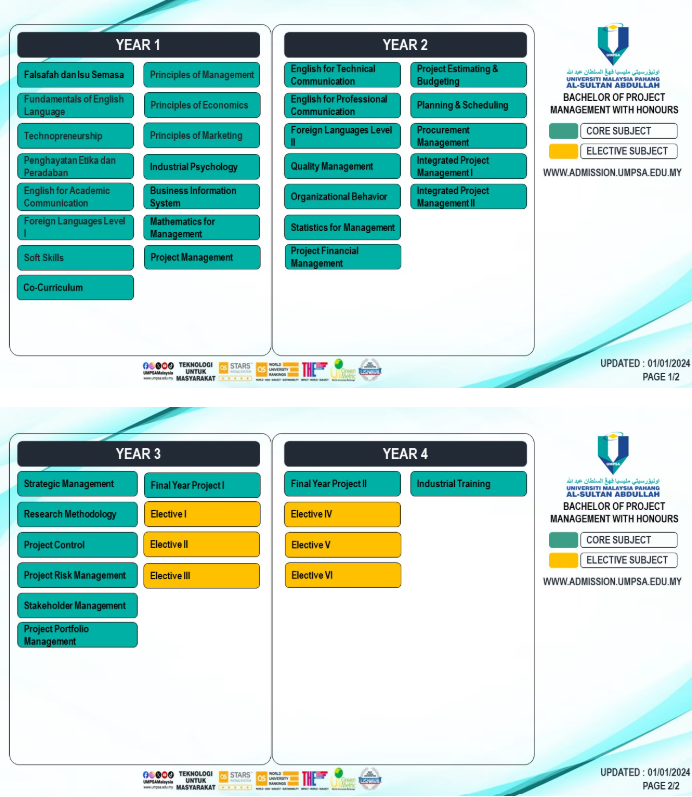
Principles of Management, Project Management and Integrated Project Management I and II connect the project to its purpose.
Ask to see how a student defines scope, deliverables and acceptance criteria.
Planning & Scheduling and Project Control put dependencies and progress into the picture.
Ask how schedule changes are tested rather than only presented in a chart.
Project Financial Management and Project Estimating & Budgeting connect spending assumptions to a plan.
Ask how uncertainty, cost changes and trade-offs are assessed.
Procurement Management and Quality Management connect supplier decisions to the required result.
Ask how a project weighs price, quality and procurement risk.
Stakeholder Management and Organizational Behavior address people whose decisions affect delivery.
Ask how communication and competing stakeholder needs are handled.
Research Methodology, Final Year Project I and II, and Industrial Training support applied work.
Ask what evidence an individual student must produce and may show in a portfolio.
The linked course-structure image is marked updated 1 January 2024. Years 1–2 establish management, economics, marketing, mathematics, statistics and project methods. Year 3 names strategy, risk, stakeholder and portfolio management alongside the first final-year project; Year 4 shows Final Year Project II, electives and industrial training. Obtain the current mode-specific curriculum for your cohort rather than assuming the image is a personalised timetable.
The faculty brochure describes two modes and says 3u1i students experience the company working environment for a year. The four-year duration already includes that industrial year; it is not four years plus another year of work. The broad structure image does not establish the exact module calendar for every 3u1i student.
A company list in a brochure is not an individual placement offer. No named host, paid allowance, guaranteed employment or independent work permission is established here. Request the allocation process, supervision, assessment, placement location, travel and insurance costs, and the fallback if a suitable host is unavailable. Confirm that your international offer actually admits you to the mode you want.
MQA accreditation and professional programme accreditation answer different questions. MQR records the exact Malaysian qualification. UMPSA’s news report dated 16 January 2025 states that the bachelor programme obtained PMI Global Accreditation Center accreditation for May 2024 to April 2029. PMI describes GAC as accreditation of academic programmes, not automatic certification of each graduate.
The university report mentions opportunities for certifications such as CAPM and access to industry reference materials. Its brochure says students receive training and guidance towards professional certifications, and that PMP-certified lecturers are part of the teaching team. None of those statements makes the bachelor graduate a PMP or CAPM holder, proves an examination fee is included, or removes separate certification conditions.
Ask which certification preparation, materials, membership and exam costs are actually included in your intake. The brochure’s older ten-knowledge-area framing and the 2025 report’s references to PMBOK 7 and the PMI Talent Triangle reflect different source dates. Do not assume an older brochure fixes the edition or certification syllabus that will apply when you graduate.
UMPSA names directions including construction project executive, contract executive, procurement executive, IT executive, facility management executive, product-development executive and quality-management executive. Its 2025 report describes project executive, project officer, project coordinator and assistant project manager as foundation roles, with progression to more senior roles after relevant experience.
The degree is not an engineering licence, a guaranteed construction-site position or a promise to start as a project manager. The faculty brochure lists Construction and Information Technology elective groups, but the current linked structure labels electives without naming the available choices. Ask which electives your cohort can actually take and whether there are prerequisites or minimum enrolments. Older brochure salary figures are not used as current graduate earnings.
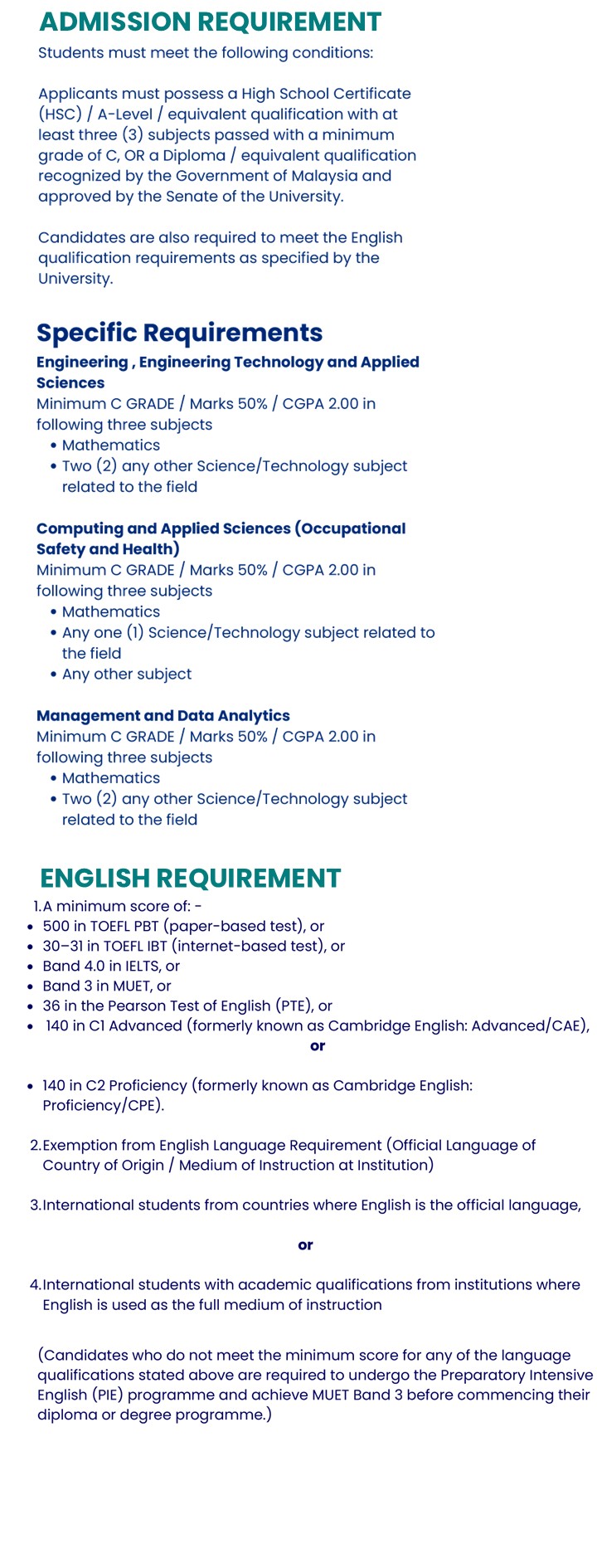
The international course page and linked entry image publish these requirements, including the science/technology wording for Management. Do not replace that unusual wording with an assumed commerce-only route. It is a subject-based requirement, not a verified overall Indian Class XII percentage. Have admissions assess your board, subjects and marks in writing.
The page additionally describes a recognised diploma of at least three years and minimum age 17 at registration. It does not establish an automatic transfer-credit amount or a shortened degree. Domestic STPM, foundation and diploma pathways in the brochure are not substituted for international requirements here.
The international page publishes practical-work health and colour-vision conditions. Applicants with relevant access needs should request an individual assessment and written accommodation guidance; this guide cannot decide eligibility or exclusion.
The international page allows an exemption route for students from countries where English is the official language, or qualifications from institutions where English was the full medium of instruction. That is a route to request with evidence, not an automatic waiver for every Indian applicant or every English-medium letter.
Applicants below the scores are directed to the Preparatory Intensive English programme and must achieve MUET Band 3 before starting the diploma or degree. Confirm the accepted evidence, test validity, preparation cost and sequence for your own offer.
Exact Project Management row in the international undergraduate schedule, 2025/2026 intake onwards. Planning estimate, not a final invoice.
The bursar schedule lists RM77,795 (approximately ₹1,797,726) for Bachelor of Project Management with Honours. The current international BPP open-intake card instead shows RM77,715 (approximately ₹1,795,877) for February 2027. These are two official-source figures to reconcile, not a discount to choose between. Ask for one dated itemised quotation naming the intake, campus, mode, credits and included charges.
The bursar says the estimate covers the normal/minimum study duration and can vary with registered credit hours. Its entrance charge is RM1,155 (approximately ₹26,690) in Semester 1 and miscellaneous charge is RM330 (approximately ₹7,626) each semester, with variation possible during WBL or training. Those charging rules are not automatic extras to add again to the programme estimate.
Accommodation/hostel and visa processing are excluded. A separate refundable Personal Bond of RM1,500 (approximately ₹34,663) is charged before registration and may be returned in full or part subject to claims. Discounts apply only under approved terms; the schedule distinguishes Pekan/Gambang from Kuala Lumpur. Your written offer, not a generic promotion, establishes your final payable fee.
The faculty brochure gives an older international per-semester figure rather than this current full-programme estimate; it is not used as the payable rate. INR comparisons use Wise’s 10 November 2026 table, MYR1 = INR23.1085, rounded to the nearest rupee. They are dated planning comparisons, not remittance quotes. Budget separately for living costs, insurance, medical checks, English preparation, devices, optional certifications and industrial-year travel.
The current BPP international card advertises February 2027. UMPSA’s general international admissions table pairs February with a December closing month and September with July. It does not fix the day, guarantee a place or establish your Student Pass processing time. Request the exact start date, international application deadline, teaching campus and mode before arranging travel.
The hero is the project-planning image on UMPSA’s BPP international card. It illustrates a person working with schedules and planning documents; it is not evidence of an identified UMPSA student, a particular teaching room or a guaranteed employer placement.
It is the four-year Bachelor of Project Management with Honours, MQA/FA2288, with 120 credits. GAC accredits the academic programme. The degree does not automatically award PMP or CAPM certification.
The faculty describes three university years and one industrial year within the four-year programme. Confirm the approved mode and semester calendar on your offer.
No individual pay, employer or job guarantee is established. Ask about host allocation, supervision, costs, assessment and fallback arrangements.
The published international specific requirements name Mathematics and two related science/technology subjects. Admissions must assess the actual board and subjects; no commerce-only exception or universal overall percentage is confirmed here.
The bursar exact course row is RM77,795 (approximately ₹1,797,726) and the February 2027 open-intake card is RM77,715 (approximately ₹1,795,877). Both are planning references until UMPSA reconciles the scope and provides a written quotation. INR comparisons and exclusions are explained in the fee section.
The international card says Pahang. MQR provides a Pekan institutional address and an additional Kuantan programme location. Confirm the exact teaching campus and industrial-year location in writing.
“The entire admission process was handled in a clear and organized manner, which made everything feel much less overwhelming.”
Fathima Meharin
MBA in Business Analytics · APU Malaysia
“They supported me from the beginning and made sure I understood each step clearly. … Their support made the whole admission process smooth and much less stressful.”
Hamda Noushad
Heriot-Watt University Malaysia
Student experiences as published on Emir Overseas' website, each displayed with five stars. Quotes reproduced exactly as published; the ellipsis is retained. These are not testimonials about the institution on this page.
Checked 11 November 2026. Programme pages, fee schedules and general application instructions can differ. The scope of each source is stated below; written intake-specific confirmation takes priority over an estimate.
Talk to our Malaysia study-abroad experts. We work with 34 partner universities. Your Malaysia study plan, with our Calicut team, starts with your qualification, chosen award, intended intake and a written fee breakdown. The partner count is general, not a claim that this institution is a named partner.
Talk to a study abroad expertOur office: Ground Floor, HiLITE Business Park, Calicut. Please arrange an appointment before visiting.